Guides
Nage-no-kata: The 15 Throws in Order, Sides and Scoring
Learn the 15 throws of nage-no-kata in Kodokan order, the side each one starts on, what uke does, and how IJF judges score every technique.
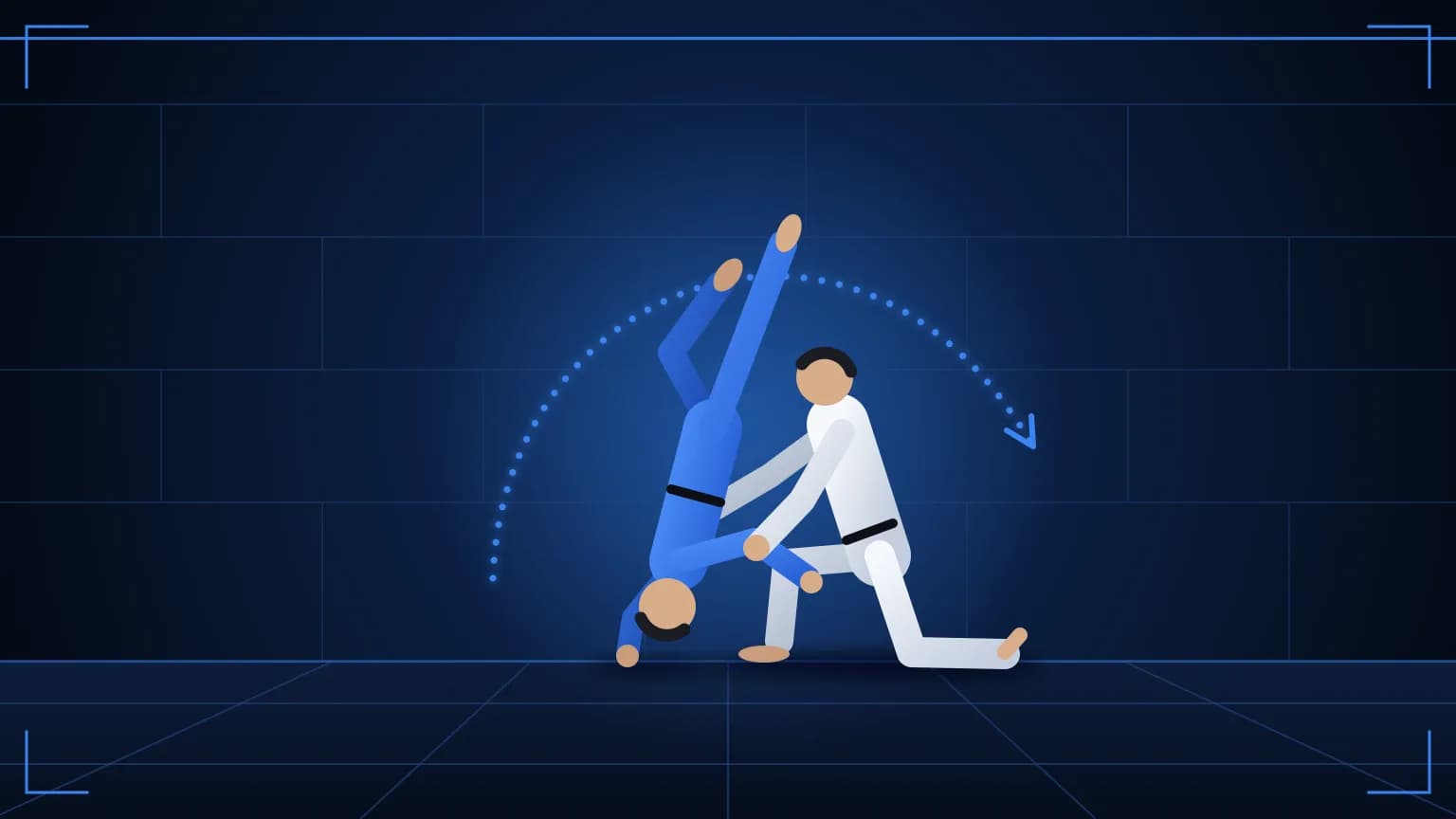
Nage-no-kata has 15 throws in five sets of three, and you perform every throw twice, once on each side. The order never changes: te-waza (uki-otoshi, seoi-nage, kata-guruma), koshi-waza (uki-goshi, harai-goshi, tsurikomi-goshi), ashi-waza (okuri-ashi-harai, sasae-tsurikomi-ashi, uchi-mata), ma-sutemi-waza (tomoe-nage, ura-nage, sumi-gaeshi) and yoko-sutemi-waza (yoko-gake, yoko-guruma, uki-waza).
Tori throws, uke attacks and takes 30 falls, and five judges score the pair if you compete. Below you get uke's attack and the starting distance for every throw from the Kodokan's own textbook, the seven throws that start on the left, the deductions IJF judges use with the 2023 world final as a worked example, and a four-week practice block.
See all 15 throws in Kodokan order
The Kodokan adopted the current nage-no-kata on April 10, 1960, amended it on November 1, 2005, and publishes the official form in its kata textbook. The textbook also calls it randori-no-kata, because it teaches the throwing principles you use in free practice. Each set takes three throws from one of the five groups in the judo throws list.
Uke opens the first run of every throw on the right side: a right-hand grip, a right fist or a right-foot step. Tori answers and throws, then you both reset for the same throw on the other side.
| # | Set | Throw | Uke opens with | Distance | Tori starts on |
|---|---|---|---|---|---|
| 1 | Te-waza | Uki-otoshi | Grip, tsugi-ashi steps | 60 cm | Right |
| 2 | Te-waza | Seoi-nage | Fist strike at the crown | 1.8 m | Right |
| 3 | Te-waza | Kata-guruma | Grip, tsugi-ashi steps | 60 cm | Right |
| 4 | Koshi-waza | Uki-goshi | Fist strike at the crown | 1.8 m | Left |
| 5 | Koshi-waza | Harai-goshi | Grip, tsugi-ashi steps | 60 cm | Right |
| 6 | Koshi-waza | Tsurikomi-goshi | Grip, tsugi-ashi steps | 60 cm | Right |
| 7 | Ashi-waza | Okuri-ashi-harai | Grip, side steps | 30 cm | Left |
| 8 | Ashi-waza | Sasae-tsurikomi-ashi | Grip, tsugi-ashi steps | 60 cm | Left |
| 9 | Ashi-waza | Uchi-mata | Grip, circling steps | 60 cm | Right |
| 10 | Ma-sutemi-waza | Tomoe-nage | Grip, then pushes back | 60 cm | Right |
| 11 | Ma-sutemi-waza | Ura-nage | Fist strike at the crown | 1.8 m | Left |
| 12 | Ma-sutemi-waza | Sumi-gaeshi | Low grip in jigotai | 90 cm | Right |
| 13 | Yoko-sutemi-waza | Yoko-gake | Grip, tsugi-ashi steps | 60 cm | Left |
| 14 | Yoko-sutemi-waza | Yoko-guruma | Strike, then bends forward | 1.8 m | Left |
| 15 | Yoko-sutemi-waza | Uki-waza | Low grip in jigotai | 90 cm | Left |
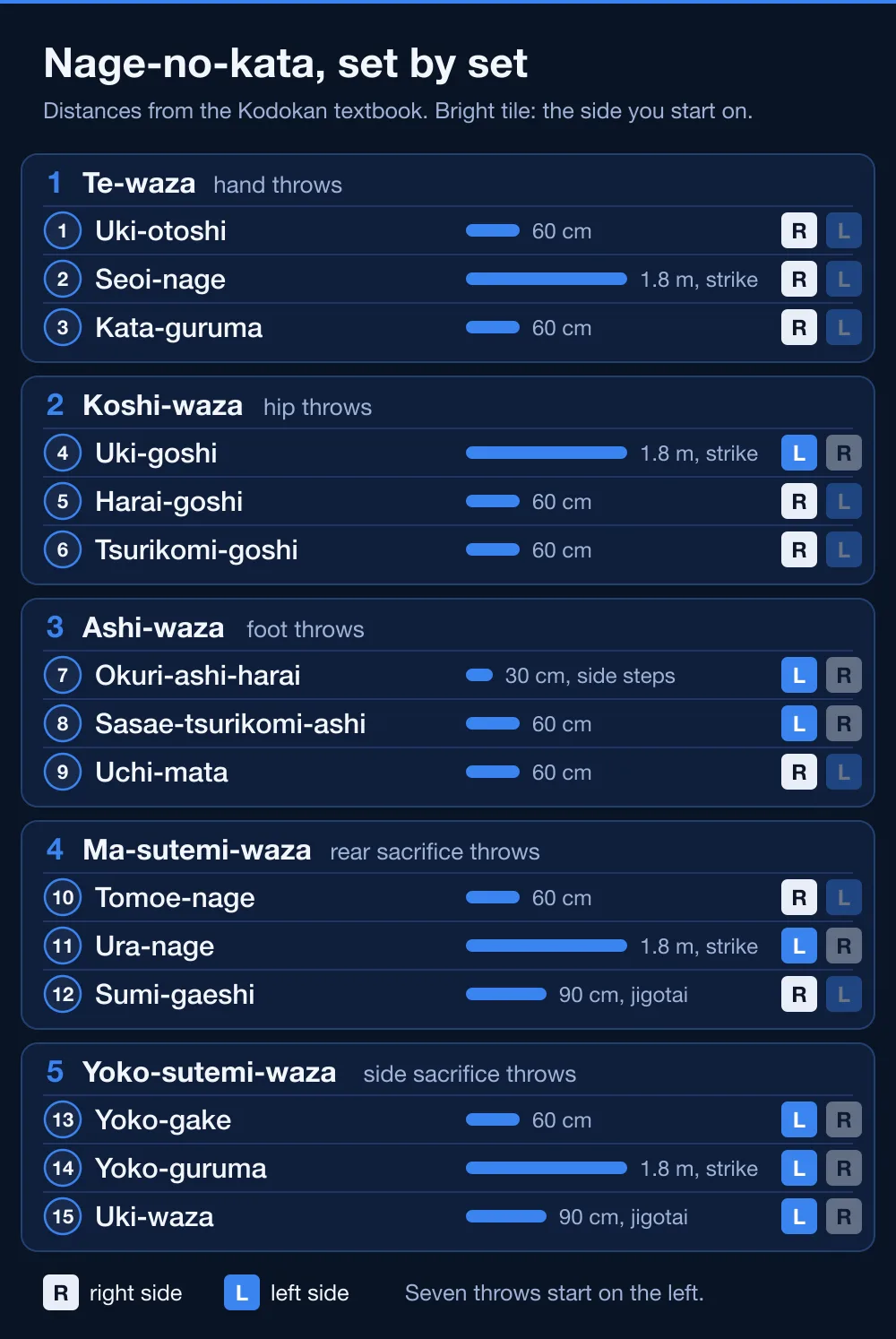
Learn the distances with the order. The textbook brings you to about 60 cm for the grip attacks, 1.8 m for the four strikes, 90 cm for the two throws from jigotai and 30 cm for okuri-ashi-harai. A wrong distance pushes every step after it out of place, and IJF judges mark it as a medium mistake.
The kata's seoi-nage loads uke with your right arm under the armpit and your hand on top of the shoulder, which matches the IJF description of ippon-seoi-nage. The seoi-nage guide compares the three shoulder-throw names.
Start seven throws on the left
You often read that every throw goes right, then left. The Kodokan textbook names each side by the hip, shoulder, foot or fall that tori uses, and seven throws answer uke's right-side attack with tori's left:
- Uki-goshi: uke strikes with the right fist, and you load uke on your left hip.
- Okuri-ashi-harai: you sweep with your left foot as uke's feet come together.
- Sasae-tsurikomi-ashi: you block uke's right ankle with your left sole.
- Ura-nage: you throw uke over your left shoulder.
- Yoko-gake, yoko-guruma and uki-waza: you fall onto your left side.
The other eight start on the right. Judges mark a throw done twice on the same side, or with its sides reversed, as a big mistake worth 5 points. A throw done on one side only counts as a forgotten technique, which costs far more.
Know what tori and uke each do
As you face the shomen, tori stands on the left and uke on the right, about 5.5 m apart (3 ken in the textbook). You bow to the shomen together standing, then turn and make a kneeling bow to each other. You rise together, step forward with the left foot into shizen-hontai and walk in for uki-otoshi.
Uke drives every throw. Commit to each attack: full weight forward on the third step of uki-otoshi, a strike aimed straight down at the top of tori's head, a push you mean in tomoe-nage. Tori breaks your balance with the footwork the textbook sets, tsugi-ashi for most grip attacks and ayumi-ashi in tomoe-nage, and throws as your weight commits. The textbook asks for continuous, relatively quick movement in the ma-sutemi-waza set.
After each set, walk back to your starting marks, straighten your judogi and turn to face each other without showing your backs to the shomen. After the last throw, right uki-waza, return to the start, step back to 5.5 m, kneel and bow to each other, then stand and bow to the shomen.
At IJF events you enter from the side opposite the shomen and open the kata at the 8 m or 10 m line, depending on the mat. Tape marks sit 3 m either side of the centre, so you start about 6 m apart. If you enter the U18 group, the draw decides who plays tori, so learn both roles.
Score the kata the way IJF judges do
Five judges sit on the shomen side, about 1.25 m apart, and each one scores every technique. For each technique the highest and the lowest score drop out, and the middle three add up. Your total is the sum of those technique scores, and in nage-no-kata your right and left throws share one score. IJF kata judges are at least 30 years old, hold at least 4th dan and carry an IJF licence for the kata they judge.
| Mistake | What it means | Deduction per judge |
|---|---|---|
| Small | An imperfection in the technique | 1 point, up to 2 marks |
| Medium | One element of the principle done wrong | 3 points, 1 mark |
| Big | The principle itself done wrong | 5 points, 1 mark |
| Forgotten technique or major mistake | A missing, swapped or abandoned technique | That technique scores zero and your total halves |
Each judge can also add or take off 0.5 point per technique as a correction value. A second forgotten technique also scores zero, but your total halves only once.
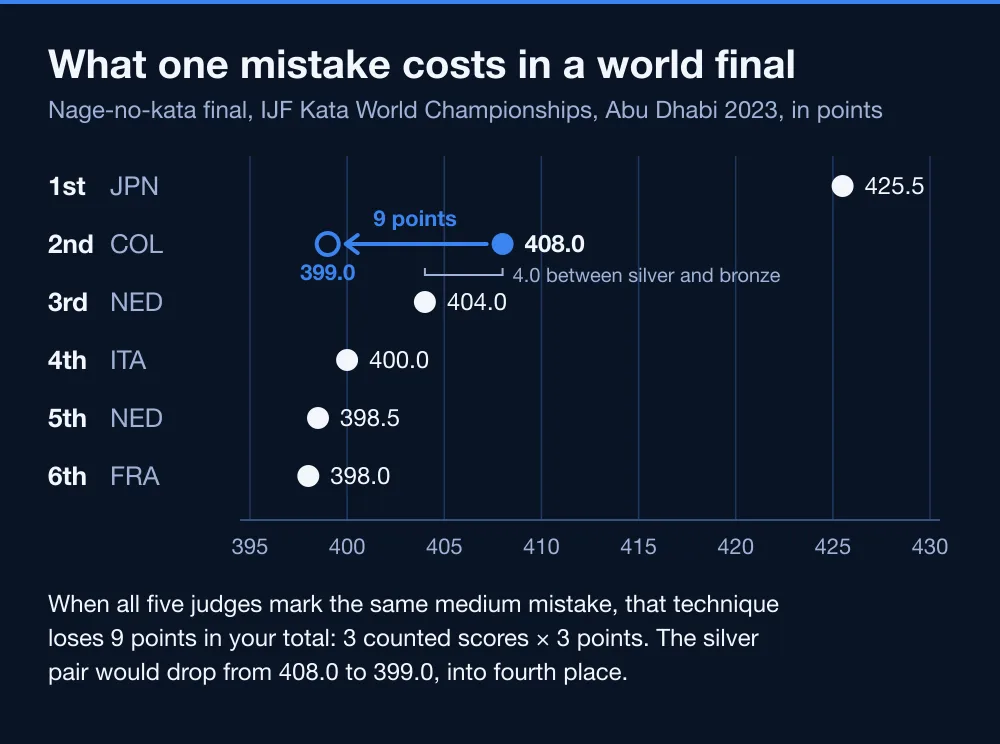
Put numbers on it with the 2023 Kata World Championships final in Abu Dhabi. The Japanese pair won nage-no-kata with 425.5 points, Colombia took silver with 408.0, the Netherlands took bronze with 404.0, and sixth place finished on 398.0. When all five judges mark the same medium mistake, that technique loses 9 points from your total: three scores count, and each one loses 3. One medium mistake that the whole panel sees costs more than the 4.0 points between silver and bronze, and it would have dropped the silver pair from 408.0 to 399.0, into fourth place. A forgotten technique zeroes that throw and halves the rest, so a 425.5 kata would finish below 213.
Avoid the mistakes judges mark
The IJF evaluation criteria list what judges look for in every throw. The first five mistakes below cost the most under the rules, and each one has a fix you can drill:
| Mistake | Judges mark | Fix |
|---|---|---|
| You perform a throw on one side only | Forgotten technique | Say each side out loud as you throw it in practice, so a missing side stands out |
| You swap two throws | Each moved throw counts as forgotten | Learn the order as five sets of three before you add detail |
| You start a throw on the wrong side | Big mistake, 5 points | Learn the seven left-first throws above |
| You stand still for more than 5 seconds | Major mistake | Rehearse the walk between throws as often as the throws |
| You talk to your partner | Major mistake | Agree every cue before you step on the mat |
| You step off with the wrong foot | Medium mistake, 3 points | Walk the footwork without throwing until it matches the textbook |
| You stand at the wrong distance | Medium mistake | Tape 30 cm, 60 cm, 90 cm and 1.8 m marks on your practice mat |
| Uke jumps in uki-otoshi | Medium mistake | Step in with full weight and let tori's pull start your roll |
| Uke strikes from the side | Medium mistake | Strike straight down at the top of tori's head, two steps in |
| Tori jumps with both feet in ura-nage | Medium mistake | Step in low, one foot after the other, and finish with both shoulders on the mat |
Harai-goshi and uchi-mata need their own attention. Judges want the harai-goshi sweep with an outstretched leg, and they want uchi-mata thrown on the third circling step with a wide, horizontal pull. The harai-goshi guide covers the sweep in randori, and the kata asks for the same straight leg.
Practise nage-no-kata in four weeks
Run this block with a partner and a coach, three sessions a week, 30 minutes each, and let your coach change the pace.
- Week 1, sets 1 and 2. Warm up with 5 minutes of breakfalls, walk the footwork for 10 minutes without throwing, then throw each technique on both sides at half speed.
- Week 2, sets 1 to 3. Add ashi-waza and run all nine throws in one go with the opening and closing bows.
- Week 3, sets 4 and 5. Learn the sacrifice throws on thick tatami with your coach watching. Uke needs a confident forward roll and side fall first.
- Week 4, the whole kata. Run it twice per session and record each run from the shomen side. Check sides, distances and pauses against the table above.
Watch a model performance before you practise. In a 2023 study, 20 judoka had 7 days to learn go-no-sen-no-kata, and the group that also watched 5 minutes of point-light video of the techniques scored better on biomechanical measures and transferred the skill better than the control group. The study was small and used another kata, so treat it as a cheap habit worth testing: watch the reference run, then copy it.
Check which sets your grading asks for
Federations ask for different parts of the kata, so check your own syllabus before you train for a grading:
| Grading or event | What you show |
|---|---|
| USA Judo shodan | The first 9 techniques, sets 1 to 3 |
| USA Judo nidan | The whole kata |
| British Judo 1st dan | Nage-no-kata, at BJA level 1 on the competitive route and level 2 on the technical route |
| IJF U18 kata, ages 15 to 17, from 3rd kyu | Sets 1 to 3, with roles drawn at random |
| IJF U21 kata from 1st kyu, senior kata from 1st dan | The whole kata |
USA Judo also accepts 10 of the 15 ju-no-kata techniques from women at shodan. Kyu and dan rules differ between federations, so compare yours in the judo belt order guide. To see which kata age group you fit in a given season, enter your birth year in the judo age categories calculator.
Stay safe as uke
A full kata gives uke 30 falls, and 12 of them come from sacrifice throws, where tori drops under you and you fly over. Head injuries in judo cluster in young athletes who get thrown: in Japanese compensation reports from 2003 to 2010, 27 of 30 catastrophic head injuries hit judoka under 20, and the authors tied them to being thrown. The study does not report kata on its own, but every kata fall uses the same mechanics.
Use these defaults:
- Learn the forward roll and the side fall before you play uke. The ukemi guide names each breakfall and the order to learn them with your instructor.
- Practise sets 4 and 5 only on tatami, with a coach watching, at learning tempo. Read the tomoe-nage guide before your first sacrifice throw.
- If you are under 18, stay with sets 1 to 3 unless your coach plans otherwise. IJF rules set the same limit for U18 kata events.
- Stop after any blow to the head. See a physician before you train again if you notice headache, dizziness, nausea or confusion.
Common questions
How many throws are in nage-no-kata?
Fifteen, in five sets of three. You perform each throw on both sides, so a full kata holds 30 throws and 30 falls for uke.
What order do the nage-no-kata throws follow?
Te-waza, koshi-waza, ashi-waza, ma-sutemi-waza, then yoko-sutemi-waza. Inside each set the order stays fixed, from uki-otoshi at the start to uki-waza at the end.
Which nage-no-kata throws start on the left?
Seven: uki-goshi, okuri-ashi-harai, sasae-tsurikomi-ashi, ura-nage, yoko-gake, yoko-guruma and uki-waza. The other eight start on the right.
Do you need nage-no-kata for your black belt?
It depends on your federation. USA Judo asks for the first 9 techniques at shodan and the whole kata at nidan, and British Judo lists nage-no-kata as its 1st dan kata. Check your own federation's syllabus.
Who plays tori in a U18 kata event?
The draw decides. IJF rules tell U18 pairs to prepare both roles in nage-no-kata, and U18 pairs perform only the first three sets.
Sources
- Kodokan Judo Institute. Kodokan Kata Textbook: Nage-no-Kata, official English translation, 2014
- International Judo Federation. Sport and Organisation Rules, version 14 August 2026, Appendix B: Regulations for Kata
- IJF Kata Commission. Kata Competition: Criteria for the Evaluation, January 2022, English
- IJF Kata Commission. Kata Competition: Criteria for the Evaluation, January 2025, Portuguese edition
- IJF Kata Commission. Kata Competition: Judges Guidelines, March 2026
- IJF Kata Commission. IJF Judo Kata World Championships, Abu Dhabi, 28 and 29 October 2023: all results
- International Judo Federation. Ippon-seoi-nage, IJF technique page
- USA Judo. Promotion Recommendation Procedures, July 30, 2025
- British Judo. Dan Grade Promotion Syllabus, July 2025
- Francisco V, Decatoire A, Bidet-Ildei C. Action observation and motor learning: the role of action observation in learning judo techniques. Eur J Sport Sci, 2023
- Kamitani T et al. Catastrophic head and neck injuries in judo players in Japan from 2003 to 2010. Am J Sports Med, 2013