Technique
De-Ashi-Barai: How to Time the Judo Forward Foot Sweep
Sweep the stepping foot just before it takes weight. Learn de-ashi-barai timing, kuzushi, drills, IJF scores and how it differs from okuri and sasae.
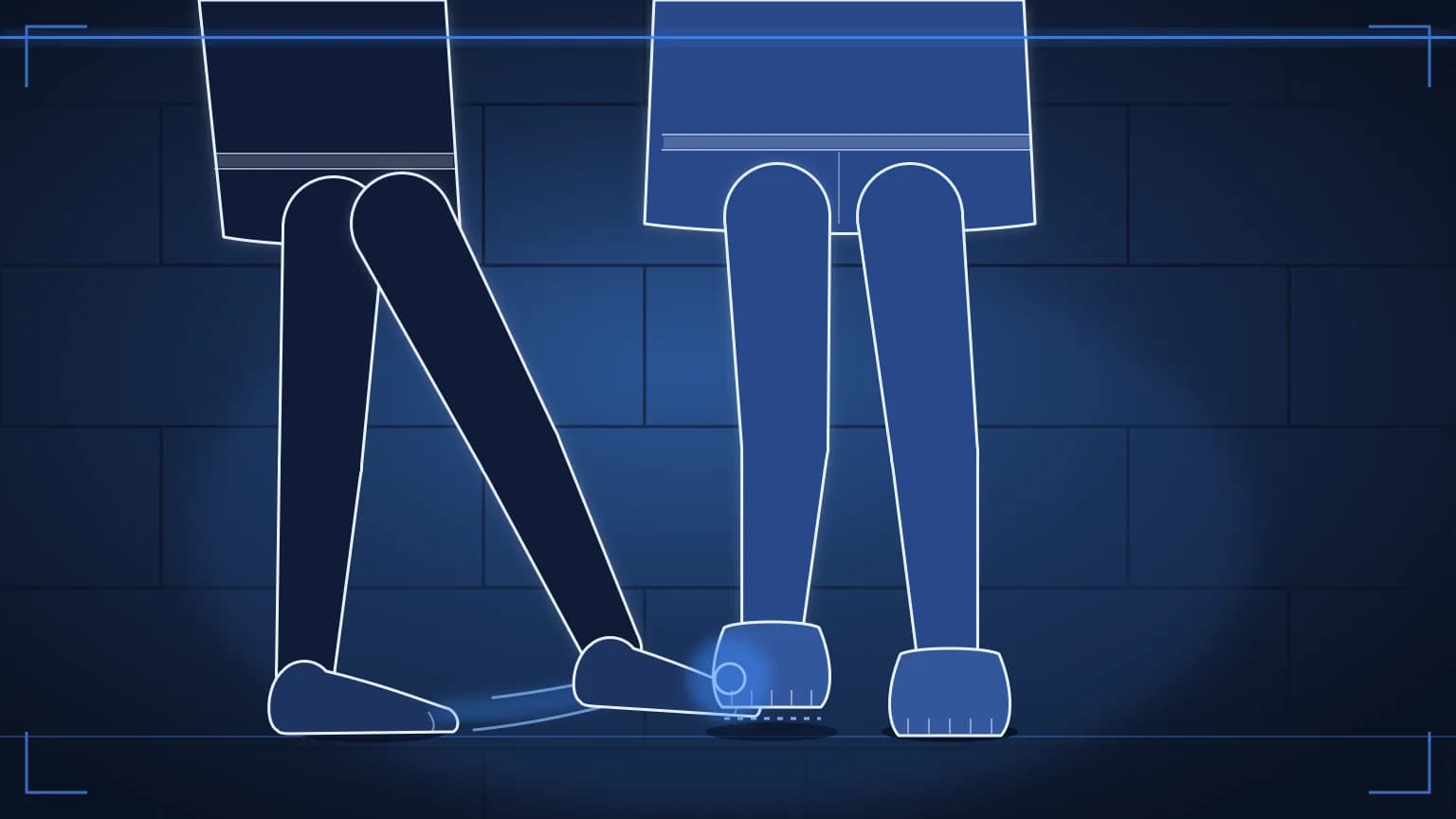
De-ashi-barai (出足払, "advancing foot sweep") is the judo throw where you sweep your partner's stepping foot with the sole of your foot at the instant they move it and are about to put weight on it. Catch that moment, steer their upper body with your hands, and they fall on their side or back with almost no effort from you.
The Kodokan lists it first among its 21 foot techniques and first in the Gokyo, the 40-throw teaching order it set in 1920. British Judo puts it on the syllabus for your very first grade. Learn the timing below before you add any other foot sweep.
Read the name and the classification
The name has three parts: de (出) means coming out or advancing, ashi (足) means foot, and harai (払) means sweep. In Japanese the h of harai softens to a b after another word, so you will see both spellings. The Kodokan and the IJF write De-ashi-harai, British Judo writes De-ashi-barai, and both name the same throw.
| Field | Value |
|---|---|
| Group | Nage-waza, tachi-waza, ashi-waza (foot and leg techniques) |
| Place in the Gokyo (1920) | Group 1, technique 1 |
| IJF/Kodokan code | DAB |
| Kodokan definition | Sweep the opponent's foot "on the verge of placing his weight on the stepping foot" |
| Direction of the sweep | From the rear, the side or the front, depending on how your partner steps |
| Status in IJF contests | Legal and scored like any classified throw |
The IJF and Kodokan classification, updated on 1 April 2017, counts 68 throws and 21 of them are foot and leg techniques. Foot techniques were the most used throwing group at the 1995, 1997 and 1999 World Championships, and de-ashi-barai is the simplest of them. Browse the rest in the judo throws list.
Time the sweep to the step
Everything in de-ashi-barai hangs on one fraction of a second. Your partner's foot passes through three states every time they step:
- In the air. The foot carries no weight, but it also has nothing to fall over. Sweep it here and you just push it further along its path.
- About to land. The heel is a few centimetres above the mat and your partner has already committed their body weight to it. This is the window. Take the foot away now and the weight they sent toward it has nowhere to go.
- Planted. The foot is loaded. Your sweep bounces off, or you end up kicking an ankle.
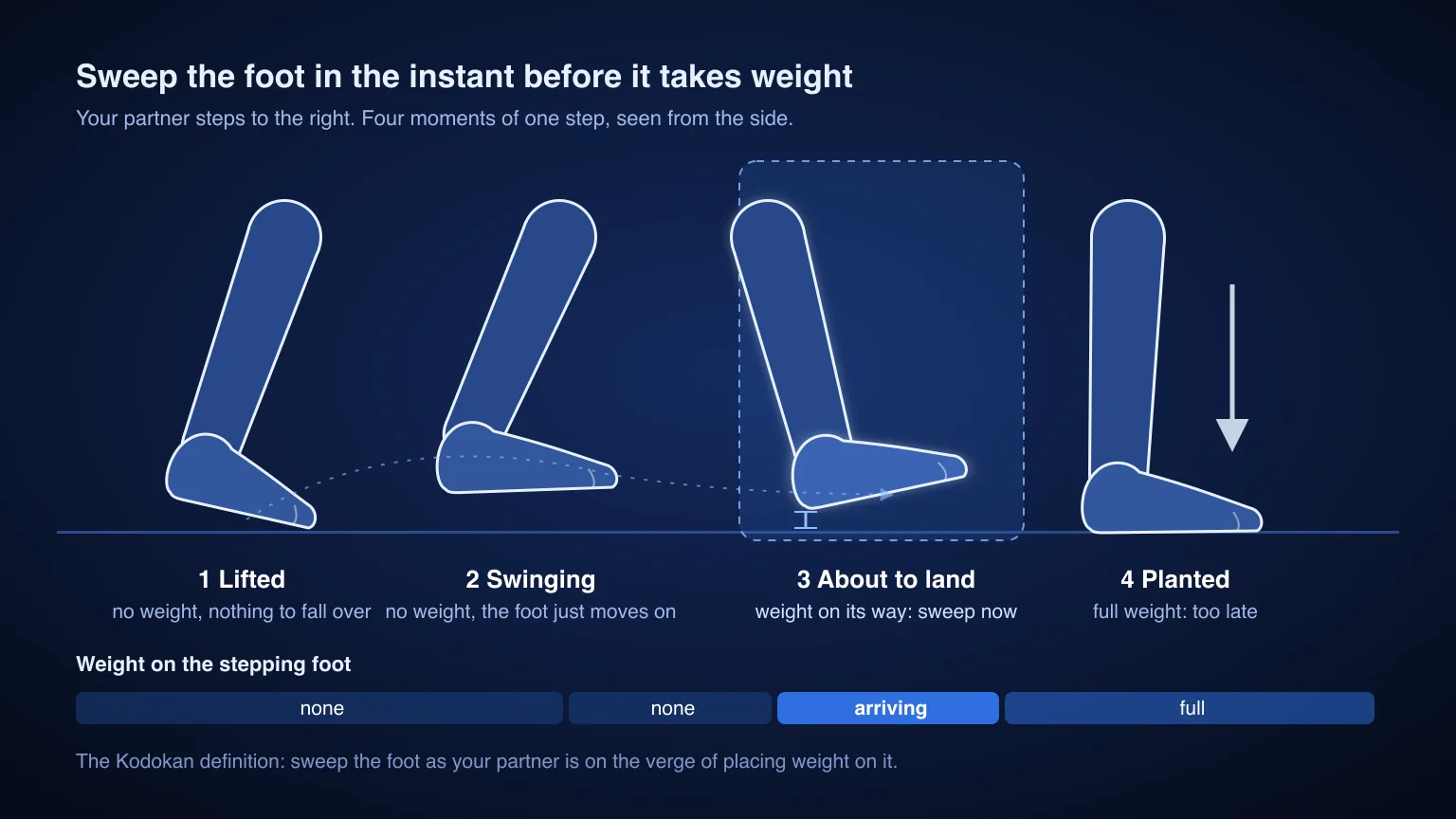
The Kodokan writes the window into the definition itself: the sweep comes "at the instant your opponent has taken a step forward or backward and is on the verge of placing his weight on the stepping foot." Read that as an order to sweep the step itself. If you watch your partner's feet you will be late. Watch their hips and shoulders instead, because the body commits a moment before the foot lands.
Break the balance, set up and sweep
Every throw splits into kuzushi (breaking the balance), tsukuri (fitting in) and kake (execution). Here is each phase for the classic version, with both of you holding a right-handed grip, your left hand on their right sleeve and your right hand on their left lapel, as your partner steps forward with the right foot.
Use kuzushi to load the stepping foot
Draw your partner forward a little with your sleeve hand so they step toward you. You want the step to happen, so give them a reason: walk backward half a pace, or pull as they reach for a grip. As their right foot comes forward, their weight starts to travel onto it. That travelling weight is your kuzushi.
Use tsukuri to keep your reach
Keep your upright posture and your weight on your right foot. Turn your left hip slightly toward your partner so your left leg can swing freely. If you stand square and close, your sweeping leg jams against their shin. If you stand too far, your foot arrives late.
Finish with kake: sole, direction, hands
- Sweep with your sole. Turn your left foot so the sole faces their heel, toes curled up, and contact the back and outer side of their right heel, below the ankle bone.
- Sweep along the mat, across their line. Drive their foot toward their other foot and a little in the direction it was already moving. Keep your foot low. A sweep at shin height turns into a kick.
- Turn their upper body with your hands. Pull your left hand down toward your left hip and lift your right hand up and across, as if you turn a steering wheel. Their body rotates over the swept foot and lands on its right side or back.
- Stay on your feet and keep the sleeve. Hold the sleeve through the landing so your partner can break the fall, then move straight to a pin if the landing earns less than ippon.
Your legs do not need strength for this. If you feel yourself sweeping hard, your timing is off.
Compare de-ashi-barai, okuri-ashi-harai and sasae-tsurikomi-ashi
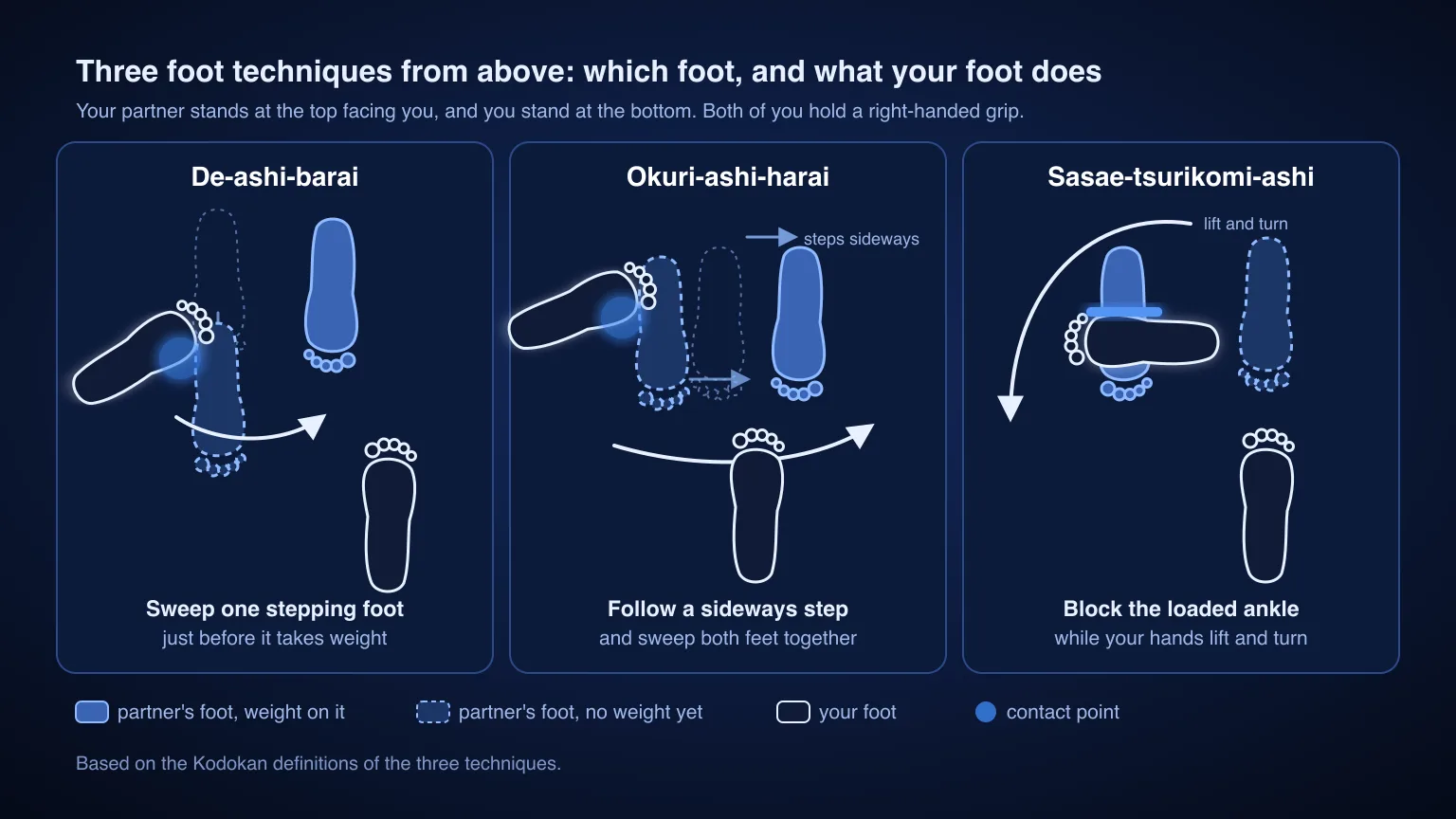
These three come up together in every grading, and two of them sit in the same Gokyo group. The Kodokan definitions separate them by which foot you attack, whether it carries weight and what your own foot does.
| De-ashi-barai | Okuri-ashi-harai | Sasae-tsurikomi-ashi | |
|---|---|---|---|
| English name | Advancing foot sweep | Foot sweep (sliding foot sweep) | Supporting-foot lift-pull throw |
| How your partner moves | Steps forward or backward | Steps sideways, feet closing together | Has their balance broken to the front corner, weight on the front foot |
| Foot you attack | The stepping foot, just before it takes weight | The trailing foot as it follows the lead foot | The supporting foot, already loaded |
| What your foot does | Sweeps one foot | Follows the movement and sweeps both feet with the whole leg | Blocks just above the ankle as a pivot, no sweep |
| Your hands | Turn the body over the swept foot | Carry the body sideways in the direction of travel | Lift and pull forward, then twist over the block |
| Gokyo (1920) | Group 1, number 1 | Group 2, number 5 | Group 1, number 3 |
| British Judo grade | Novice to 6th kyu | 4th to 3rd kyu | 4th to 3rd kyu |
Three more neighbours cause confusion:
- Harai-tsurikomi-ashi sweeps the ankle from the front after you pull and lift your partner forward. The lift comes first and the sweep sends the foot backward.
- Ko-soto-gari sweeps a foot that already carries weight, after you push your partner's balance to the rear. De-ashi-barai attacks a foot on its way down.
- Tsubame-gaeshi is the counter to de-ashi-barai. When your partner tries it on your right foot, you lift that foot away by bending the knee and sweep them with your own left de-ashi-barai.
Okuri-ashi-harai and sasae-tsurikomi-ashi both appear in the foot-technique set of the nage-no-kata. De-ashi-barai does not, so you learn it in randori and grading syllabi.
Know how a sweep scores under the 2026 IJF rules
De-ashi-barai is a Kodokan classified technique, so a clean sweep earns any score. The IJF Sport and Organisation Rules (version of 14 August 2026) judge the landing:
| How your partner lands | Score |
|---|---|
| On the back with speed, force and control to the end of the landing | Ippon |
| Past 90 degrees of the shoulder axis, but short of a full back landing, or a back landing missing one ippon criterion | Waza-ari |
| On the side at 90 degrees, on the upper back, on one buttock, or on both buttocks | Yuko |
| Front of the stomach, both hips or both knees touch first | No score |
Foot sweeps often land sideways, so expect plenty of yukos while you learn. Yukos count 1, 2, 3 and so on, but they never add up to a waza-ari. Two waza-ari still make ippon.
Run one example. You sweep in the second minute and your partner lands on the right side and right elbow: yuko. Ten seconds later you catch the same step, turn the steering wheel fully, and they land flat on the back with speed: ippon, contest over. The only change was your hands. The rules also say a fall with no clear technique scores nothing, so finish the sweep with your hands every time. Read the full system in the judo rules guide.
Find the moments to attack in randori
Your partner hands you the step. Learn to recognise it:
- As they step in to grip. The first forward step of a grip exchange is the textbook chance. Your grip fighting decides whether you can steer them when it comes.
- As they step back. The Kodokan definition covers backward steps too. Sweep the retreating foot from the front just before it lands.
- As they circle. A sideways step that brings the feet together belongs to okuri-ashi-harai. A sideways step that opens the feet still gives you de-ashi-barai on the lead foot.
- After a feint. A small ko-uchi-gari makes your partner lift and replace a foot. Sweep it as it comes down.
- In opposite stances. In a study of the 775 standing scores at the 2013 World Championships, 82.6% came from direct attacks and 67.2% came with the two athletes in opposite stances. Opposite stances put your partner's lead foot on the same line as yours, within easy reach of a sweep.
Drill the timing in four weeks
Use this plan two sessions a week alongside your normal class. Ask your coach to adjust the volume.
- Week 1: touch drill. Your partner walks toward you in a straight line. On every right step, touch the back of the heel with your left sole just before it lands, without sweeping. Do 3 sets of 10 touches on each side. The goal is a soft, silent touch at the right instant.
- Week 2: moving uchikomi. Your partner walks 4 steps, and on step 5 you sweep with full hand action but stop before the throw. Do 3 sets of 10 on each side.
- Week 3: nagekomi. Throw for real on a crash mat, 2 sets of 5 on each side. Your partner breakfalls every time.
- Week 4: trigger randori. Fight 3 rounds of 2 minutes in which de-ashi-barai is your only allowed throw. You learn to create the step yourself.
Add one combination once the sweep works: de-ashi-barai into o-soto-gari when your partner steps back to escape, or ko-uchi-gari into de-ashi-barai. British Judo pairs the sweep with a transition into mune-gatame at the first grade, and with good reason. At the 2018 World Championships, 68.6% of groundwork scores came after a failed standing attack. Follow your sweep to the ground and use the osaekomi-waza guide for the pin.
Fix the mistakes that kill the sweep
- You sweep a planted foot. Your partner doesn't move and your shin hurts. Fix: watch the hips, and start your sweep as their weight travels, before the heel lands.
- You kick with your toes or shin. It hurts your partner and throws nobody. Fix: turn the sole toward the heel and keep your ankle relaxed, like a broom along the floor.
- You sweep too high. The foot lifts but your partner hops and stays up. Fix: aim below the ankle bone and keep your foot on the mat until contact.
- You bend at the waist. Your partner pulls you forward and you lose your own balance. Fix: stand tall, hips under your shoulders, weight on your supporting foot.
- Your hands stop. The foot flies out but your partner lands on a hip or their knees. Fix: turn the steering wheel through the whole landing.
- You sweep toward yourself. The foot comes back at your own leg. Fix: sweep across their line, toward their other foot.
- You wait for a step that never comes. Fix: make them step with a pull, a backward half pace or a feint.
Practise the sweep safely
Your partner falls from standing height on every rep. Learn side breakfalls first with the ukemi guide. As uke, slap the mat with your arm and keep it there. A study of 4,614 elbow injuries in Japanese teenage judoka found that 56.2% of middle school and 54.6% of high school elbow injuries happened when an opponent threw a player and the player put a hand out to stop the fall.
As tori, sweep with your sole and keep contact low so you never strike the ankle bone. Hold the sleeve through every landing. If an ankle swells or you cannot put weight on it after a sweep, stop for the day and get it checked by a physician.
Get quick answers
What does de ashi barai mean?
It means "advancing foot sweep." De means coming out or advancing, ashi means foot and barai, or harai, means sweep.
Is it de ashi barai or de ashi harai?
Both. The Kodokan and the IJF write De-ashi-harai, and British Judo writes De-ashi-barai. The h softens to a b in Japanese when harai follows another word.
What is the difference between de ashi barai and okuri ashi barai?
De-ashi-barai sweeps one foot as your partner steps forward or backward. Okuri-ashi-harai follows a sideways step and sweeps both feet together with your whole leg.
What is the difference between de ashi barai and sasae tsurikomi ashi?
De-ashi-barai sweeps a foot that has not taken weight yet. Sasae-tsurikomi-ashi blocks the loaded supporting ankle with your sole while your hands lift and turn your partner over it.
Can de ashi barai score ippon?
Yes. A sweep that lands your partner on the back with speed, force and control scores ippon under the IJF rules. A side landing scores yuko.
What belt learns de ashi barai?
Under the British Judo kyu syllabus you learn it for your first grade, from novice to 6th kyu, together with o-soto-otoshi and uki-goshi. Okuri-ashi-barai and sasae-tsuri-komi-ashi come later, at 4th to 3rd kyu.
Check the sources
- Kodokan. Names of Judo Techniques and Go Kyo no waza
- IJF/Kodokan Classification of Judo (hosted by British Judo)
- International Judo Federation. De-ashi-harai technique page
- International Judo Federation. Sport and Organisation Rules, version 14 August 2026
- British Judo. Kyu Grade Promotion Syllabus, January 2025
- Mayo X and colleagues. An analysis model for studying the determinants of throwing scoring actions during standing judo. Sports. 2019
- Dopico-Calvo X and colleagues. Analysis of successful behaviors leading to groundwork scoring skills in elite judo athletes. Int J Environ Res Public Health. 2022
- Nakamura I and colleagues. Analysis on World Senior Judo Championships in 1995 to 1999. Research Journal of Budo. 2002
- Ikumi A and colleagues. Incidence of elbow injury patterns in Japanese adolescent judo players. Sports. 2024
- Judo AI: Dojo Partner on the App Store