Technique
Judo Armlocks: All 10 Kansetsu-Waza, Rules and Safety
Learn the 10 Kodokan judo armlocks with names and cues, juji-gatame step by step, what the IJF rules allow, the age limits, and how to train them safely.
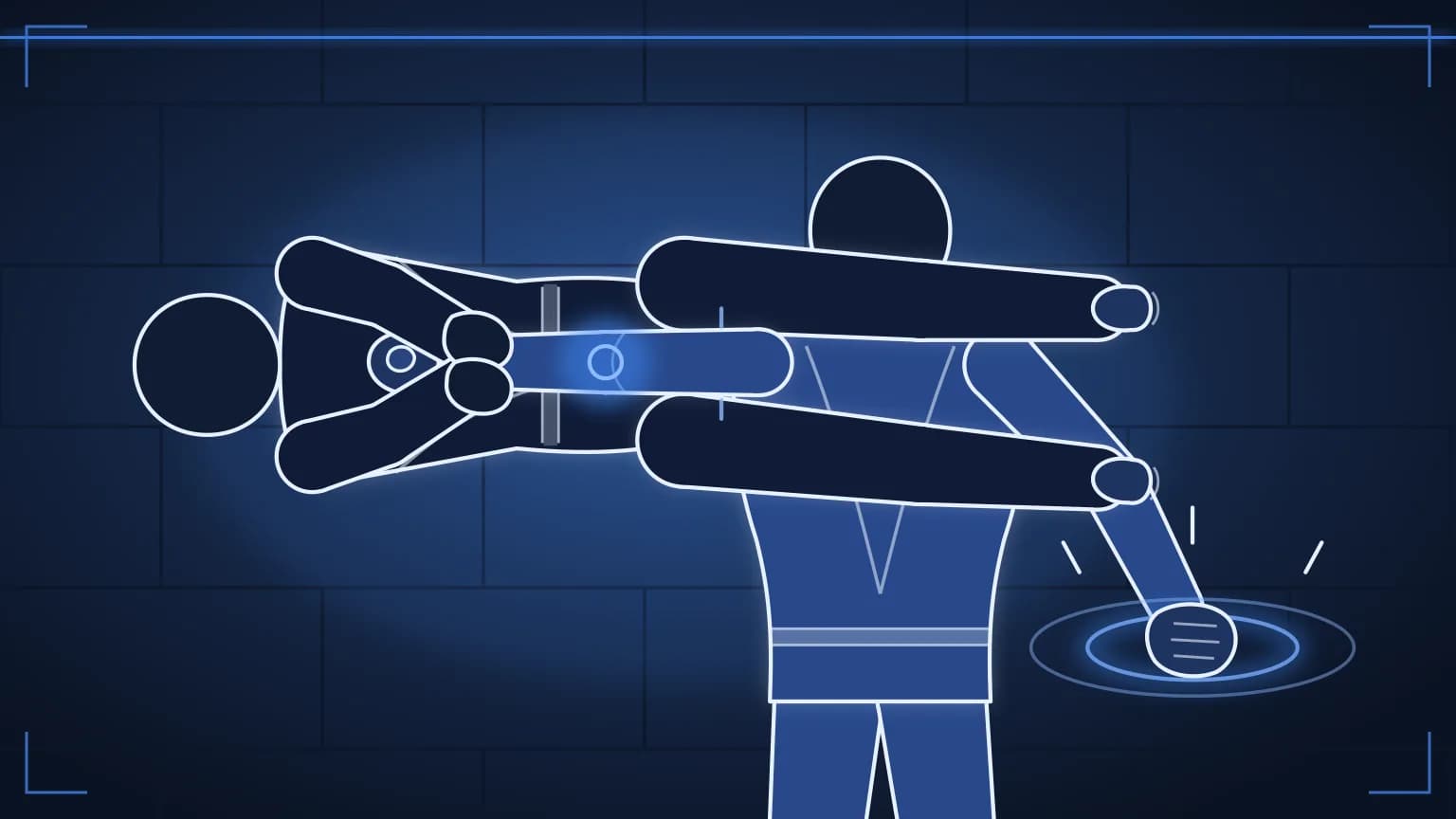
Judo has 10 official armlocks, called kansetsu-waza, in the Kodokan classification. Nine attack the elbow and are legal in IJF competition from age 15. The tenth, ashi-garami, attacks the knee and is banned. Juji-gatame, the cross armlock you probably call the judo armbar, is the one British Judo asks you to show from four different entries.
You win by ippon when your partner taps twice or says "maitta." In practice, tap early, release the instant your partner taps, and apply every lock slowly enough for them to respond.
See all 10 kansetsu-waza at a glance
The IJF and Kodokan classification, updated on 1 April 2017, lists 32 grappling techniques: 10 pins, 12 strangles and 10 joint locks. Eight of the joint locks carry the prefix ude-hishigi, "arm crush," which most coaches drop in speech. The "How it works" column paraphrases the Kodokan definitions. The cue is the one detail that makes each lock work.
| Name | Full Kodokan name | English | How it works | One cue | IJF status |
|---|---|---|---|---|---|
| Ude-garami | Ude-garami | Entangled armlock | Both your arms make a figure-four on their bent arm and twist the elbow | Keep their elbow bent at a right angle and slide the wrist along the mat toward their hip | Legal |
| Juji-gatame | Ude-hishigi-juji-gatame | Cross armlock | Their upper arm sits between your thighs while you straighten the elbow | Point their thumb at the ceiling and squeeze your knees | Legal |
| Ude-gatame | Ude-hishigi-ude-gatame | Straight armlock | Their wrist sits between your neck and shoulder while both hands press the elbow | Keep the wrist at your neck, thumb side down, and press the elbow with both palms | Legal |
| Hiza-gatame | Ude-hishigi-hiza-gatame | Knee armlock | You hold their arm under your armpit and press your knee on the elbow | Trap the wrist tight, then lean your knee in | Legal |
| Waki-gatame | Ude-hishigi-waki-gatame | Armpit armlock | You grip the wrist with both hands and clamp the arm under your armpit | Turn your chest down onto the back of the elbow | Legal on the ground |
| Hara-gatame | Ude-hishigi-hara-gatame | Stomach armlock | You hold the wrist and press your abdomen against the elbow | Lean your belly in slowly | Legal |
| Ashi-gatame | Ude-hishigi-ashi-gatame | Leg armlock | Your leg hooks the forearm of a face-down partner and straightens the elbow | Lay your leg over the forearm and push with your hips | Legal |
| Te-gatame | Ude-hishigi-te-gatame | Hand armlock | Your hands and arm straighten the elbow, or twist the wrist behind their back | Lock the elbow only. The shoulder version is banned | Legal on the elbow |
| Sankaku-gatame | Ude-hishigi-sankaku-gatame | Triangle armlock | Your legs lock a triangle around neck and armpit while your hands straighten the arm | Close the triangle first, then extend the arm | Legal |
| Ashi-garami | Ashi-garami | Leg entanglement | Your leg wraps their leg and locks the knee | None for contest | Prohibited |
The Kodokan also defines the cross armlock precisely: from your partner's right side, you hold the right wrist with both hands, trap the upper arm between your thighs and extend the elbow "in the direction of his little finger." That last phrase is the thumb-up cue in the table.
Do juji-gatame step by step
Start with the version every syllabus teaches first: your partner lies on their back and you kneel at their right side. British Judo asks for four juji-gatame entries at 4th to 3rd kyu: the sit-back entry below, a rollover, an over-the-shoulder entry and an entry from underneath.
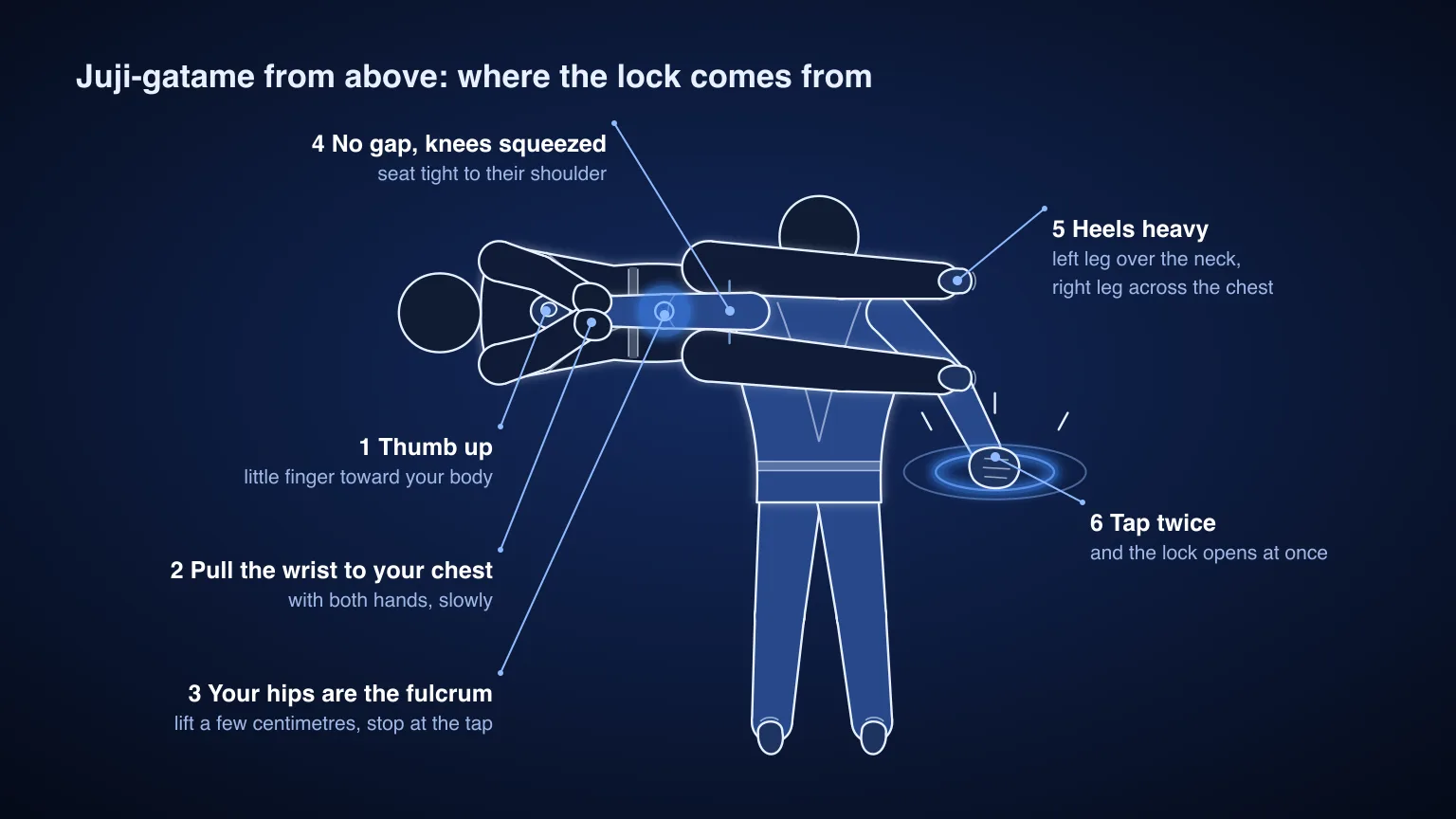
- Control the arm. Hug their right arm to your chest with both arms, their wrist near your collarbone.
- Get close to the shoulder. Squat and bring your seat right next to their right shoulder. The gap between your crotch and their armpit decides the lock: no gap, no escape.
- Swing the leg over the head. Put your left leg across their face or neck, heel down, so they cannot sit up.
- Lay the other leg across the chest. Your right leg crosses their chest. Both heels stay heavy on the mat.
- Sit back at a right angle. Lie back so your body forms a cross with theirs, which gives juji-gatame, "cross lock," its name.
- Turn the thumb up and squeeze your knees. Hold the wrist with both hands, their little finger toward your body.
- Lift your hips slowly. Pull the wrist toward your chest and raise your hips a few centimetres. The elbow joint sits on your pelvis as the fulcrum. Stop the moment your partner taps.
Most of the pressure comes from steps 2 and 6. If you need your arm strength to finish, go back and close the gap at the shoulder.
Break the grip when they hold their hands together
Your partner will clasp their hands or grab their own lapel to keep the arm bent. Keep your knees squeezed and attack one link at a time: push their far arm away with your foot, or slide your forearm into the crook of their elbow and lever it open. Never yank the arm straight. A sudden jerk takes away the time your partner needs to tap.
Learn these five first
British Judo introduces kansetsu-waza at 4th to 3rd kyu with ude-gatame, waki-gatame, hiza-gatame and juji-gatame, then adds ude-garami at 3rd to 2nd kyu. That order works for most adults:
- Juji-gatame. The lock British Judo asks you to enter four ways, and the base of the others.
- Ude-gatame. The simplest straight armlock when your partner pushes you away with a straight arm.
- Waki-gatame. Learn it on the ground first, and keep it there in randori.
- Hiza-gatame. It teaches you to control the wrist before you add pressure.
- Ude-garami. Your answer when the arm stays bent. Go slowly: it loads the shoulder as well as the elbow.
Under British Judo rules, if you hold a junior licence and are under 16, you learn these to understand them, but you do not apply them to the point of submission.
Know what the IJF rules allow
The IJF Sport and Organisation Rules (version of 14 August 2026) set the contest limits. They allow kansetsu-waza only against the elbow joint.
Win by ippon with an armlock
Your partner taps twice or more with a hand or foot, says "maitta," or loses consciousness from a lock. A hansoku-make against your partner also gives you a win equal to ippon. A lock that starts inside the contest area can continue outside it as long as you keep progressing, and if your partner holds you in osaekomi, you can still counter from underneath with an armlock.
Avoid the penalized armlock actions
| Action | Penalty |
|---|---|
| Attempting an armlock or choke from standing | Mate and shido |
| Applying an armlock from standing without a throw, or with a lower-risk throw, where your partner can still escape | Shido |
| Applying an armlock from standing with a higher-risk throw, where your partner cannot escape | Hansoku-make |
| Locking the shoulder as a variation of te-gatame | Hansoku-make |
| Locking any joint other than the elbow, such as ashi-garami | Hansoku-make |
| Overstretching your partner's leg while you lock the arm | Mate and shido |
| Putting pressure on the neck or spine from an ushiro-sankaku grip | Hansoku-make |
Read the last row closely if you like sankaku-gatame. The rules give an ushiro-sankaku entry into an armlock as an allowed example, but the same grip with neck or spine pressure is hansoku-make.
Check the age limits
| Body or event | First age for armlocks |
|---|---|
| IJF events | 15, the minimum age to enter any IJF event, cadets included |
| IJF veterans, 60 and older | Allowed. Only chokes are removed from the M7 to M9 and F7 to F9 divisions |
| British Judo | Allowed in cadet, junior, senior and veteran categories. Banned in any category exclusively for athletes under 16, or for School Year 9 and below |
| USA Judo Junior Olympics 2026 | 15 to 20 (cadet and IJF junior). Ages 13 and 14 may choke but may not armlock, and novice divisions do neither |
Applying an armlock where an event bans it costs you hansoku-make under British Judo rules, submission or not. Read your own event's bulletin before you compete, and use the judo penalty checker for the rest of the penalty list.
See how often armlocks win at the top
Armlocks are rare winners, which is exactly why a reliable one pays off. A study of the 2018 World Championships in Baku watched 794 contests and found 176 groundwork scores: 74.4% were pins, 14.2% chokes and 11.4% armlocks, about 20 in the whole event.
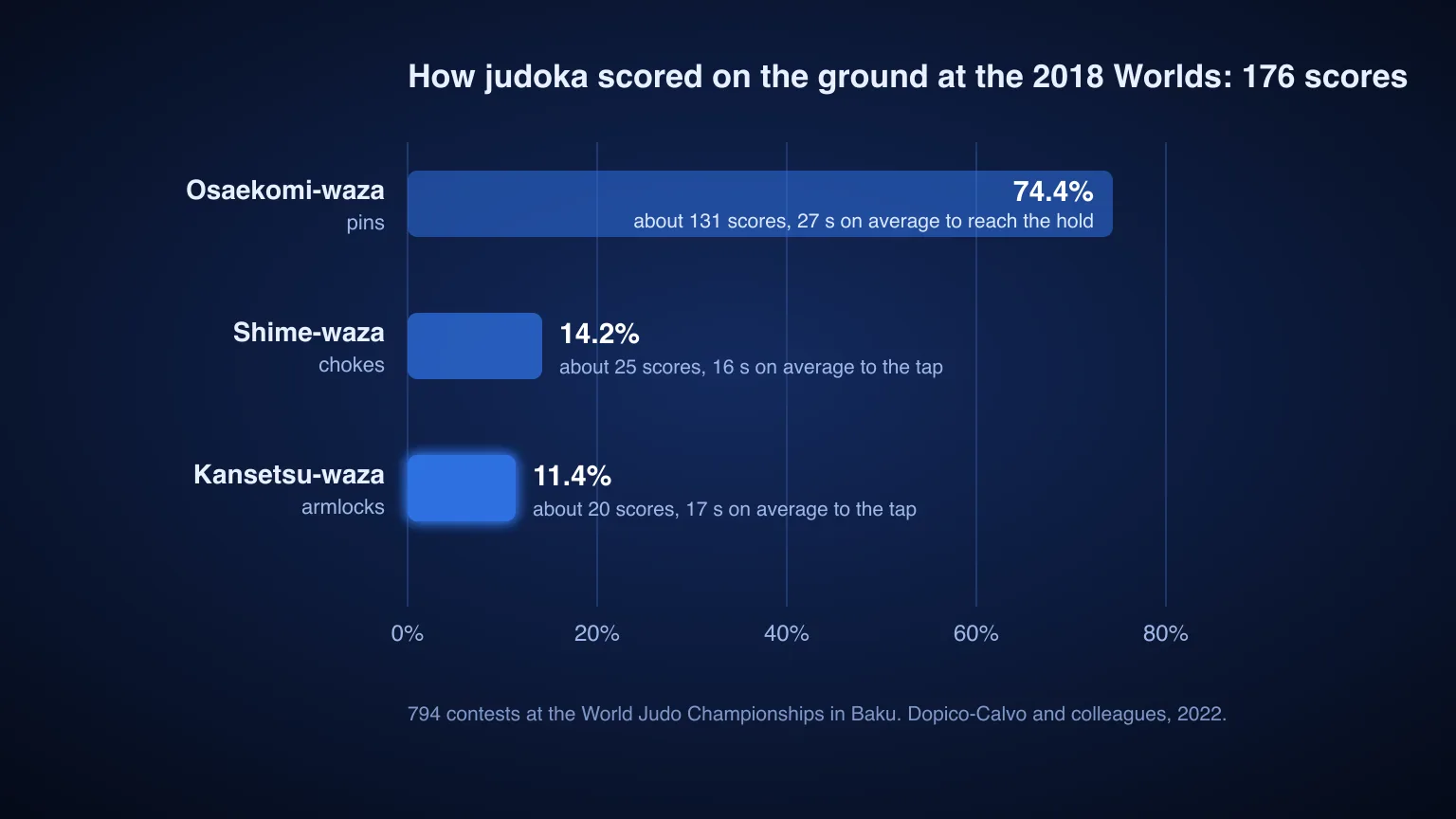
The same study gives you three practical facts:
- Armlocks finish fast. Armlock sequences took about 17 seconds from the start of groundwork to the tap, while pin sequences took about 27 seconds to reach osaekomi. Work quickly, because the referee calls mate when groundwork stops progressing.
- They follow movement. Armlocks and chokes went with long sequences of two to six position changes, while pins went with zero or one.
- They follow failed throws. 68.6% of all groundwork scores came after a failed standing attack. When a throw fails and your partner turns to their front, look for the arm.
Men scored more armlocks and chokes, and women more pins. Build juji-gatame into the moment after a stuffed throw, and pair it with the pins in the osaekomi-waza guide and the strangles in the judo chokes guide.
Read the injury research honestly
Armlocks hurt the elbow when a partner taps late or a lock goes on fast. The research shows where the risk sits.
Count the elbow injuries joint locks cause
Among Japanese judoka aged 12 to 18, an insurance database recorded 4,614 elbow injuries from 2010 to 2019. The authors report that joint locks, which Japanese school judo allows from high school, made up 17.0% of all elbow injuries, mostly sprains. Of 23 nerve injuries that came with elbow injuries, 17 hit the ulnar nerve, the nerve that serves your ring and little fingers.
Expect twisting locks to load the shoulder
In a study of 22 judoka who rated 28 variations of 9 kansetsu-waza, the elbow was the most painful region for 16 techniques and the shoulder for 8. Straight locks hurt the elbow. Twisting locks, such as variations of ude-garami, hiza-gatame and sankaku-gatame, hurt the shoulder, even though the rules only allow elbow locks. Twist slowly, and ask your partner where they feel it.
Tap before the inner elbow tears
In five Brazilian jiu-jitsu fighters injured by an armbar in a tournament, MRI showed damage to the inner side of the elbow: the common flexor tendon and the ulnar collateral ligament. The authors traced it to hyperextension with the forearm in a neutral position. All five reported pain, and the authors followed them for about 4.6 months.
Expect a dislocation to cost you about three months
In a European Judo Union survey, 108 judoka who had a simple elbow dislocation treated without surgery answered questions about their return. 69% lost less than three months, and 68% returned to their previous level. Across 21 seasons of French competitions, 421,670 contests produced 3,511 injuries, and women had a higher rate of elbow dislocations than men.
Get the elbow checked by a physician the same day if it looks deformed, swells fast, will not straighten or bend, or if your ring and little fingers tingle or go numb. Stop training after any lock that leaves you with pain at the inner elbow.
Train armlocks safely
- Learn every lock from a qualified coach. Drill the position without pressure until your hands and legs go to the right place on their own.
- Tap early and tap twice. Tap your partner or the mat hard enough to hear. If your hands are trapped, tap with your foot or say "maitta."
- Release the instant your partner taps. Open your legs, let go of the wrist, then check on them.
- Build pressure over two or three seconds. A lock needs no speed to work. Slow pressure gives your partner time to tap.
- Keep armlocks on the ground. Standing locks draw shido or hansoku-make, and the IJF ties the harsher penalty to throws your partner cannot escape.
- Respect the age rules in the dojo too. Follow your federation's limits in randori with juniors.
- Tap on the shoulder too. If a twisting lock hurts your shoulder before your elbow, that is a real tap.
Get quick answers
How many armlocks are there in judo?
Ten in the Kodokan classification. Nine attack the elbow and are legal in IJF contests, and ashi-garami, a knee lock, is prohibited.
What is the judo armbar called?
Juji-gatame, short for ude-hishigi-juji-gatame, the cross armlock. Your body forms a cross with your partner's while their arm sits between your thighs.
Are leg locks allowed in judo?
No. The IJF rules allow locks on the elbow joint only, and applying a lock to any other joint, such as ashi-garami on the knee, is hansoku-make.
At what age can you do armlocks in judo?
From 15 in IJF events and in USA Judo's 2026 Junior Olympics, where 13 and 14-year-olds may choke but not armlock. British Judo bans armlocks in any category exclusively for athletes under 16.
Can you do armlocks standing in judo?
No. An attempt from standing brings mate and shido, and a standing armlock with a throw your partner cannot escape is hansoku-make.
What is the difference between ude-garami and juji-gatame?
Ude-garami twists a bent elbow with a figure-four of your arms. Juji-gatame straightens the elbow between your thighs.
Check the sources
- IJF/Kodokan Classification of Judo (hosted by British Judo)
- Kodokan. Names of Judo Techniques, Kansetsu-waza
- International Judo Federation. Sport and Organisation Rules, version 14 August 2026
- British Judo. Amendments to IJF Contest Rules, July 2026
- British Judo. Kyu Grade Promotion Syllabus, January 2025
- USA Judo. 2026 Junior Olympics Entry Packet, 17 April 2026
- Dopico-Calvo X and colleagues. Analysis of successful behaviors leading to groundwork scoring skills in elite judo athletes. Int J Environ Res Public Health. 2022
- Ikumi A and colleagues. Incidence of elbow injury patterns in Japanese adolescent judo players. Sports. 2024
- Sannohe N. The study of the effect of kansetsu-waza in judo: the most painful regions. Research Journal of Budo. 2005
- Almeida MS and colleagues. Analysis of the pattern and mechanism of elbow injuries related to armbar-type armlocks in jiu-jitsu fighters. Acta Ortop Bras. 2017
- Lambert C and colleagues. Return to sport after conservative treatment of elbow dislocation in judoka. Sportverletz Sportschaden. 2023
- Frey A and colleagues. Epidemiology of judo-related injuries in 21 seasons of competitions in France. Orthop J Sports Med. 2019
- Judo AI: Dojo Partner on the App Store