Guides
Judo vs Karate: Which Art Fits Your Goal
Compare judo and karate on scoring, contact, age rules, injury data and Olympic status, then pick one with a trial class checklist built for your goal.
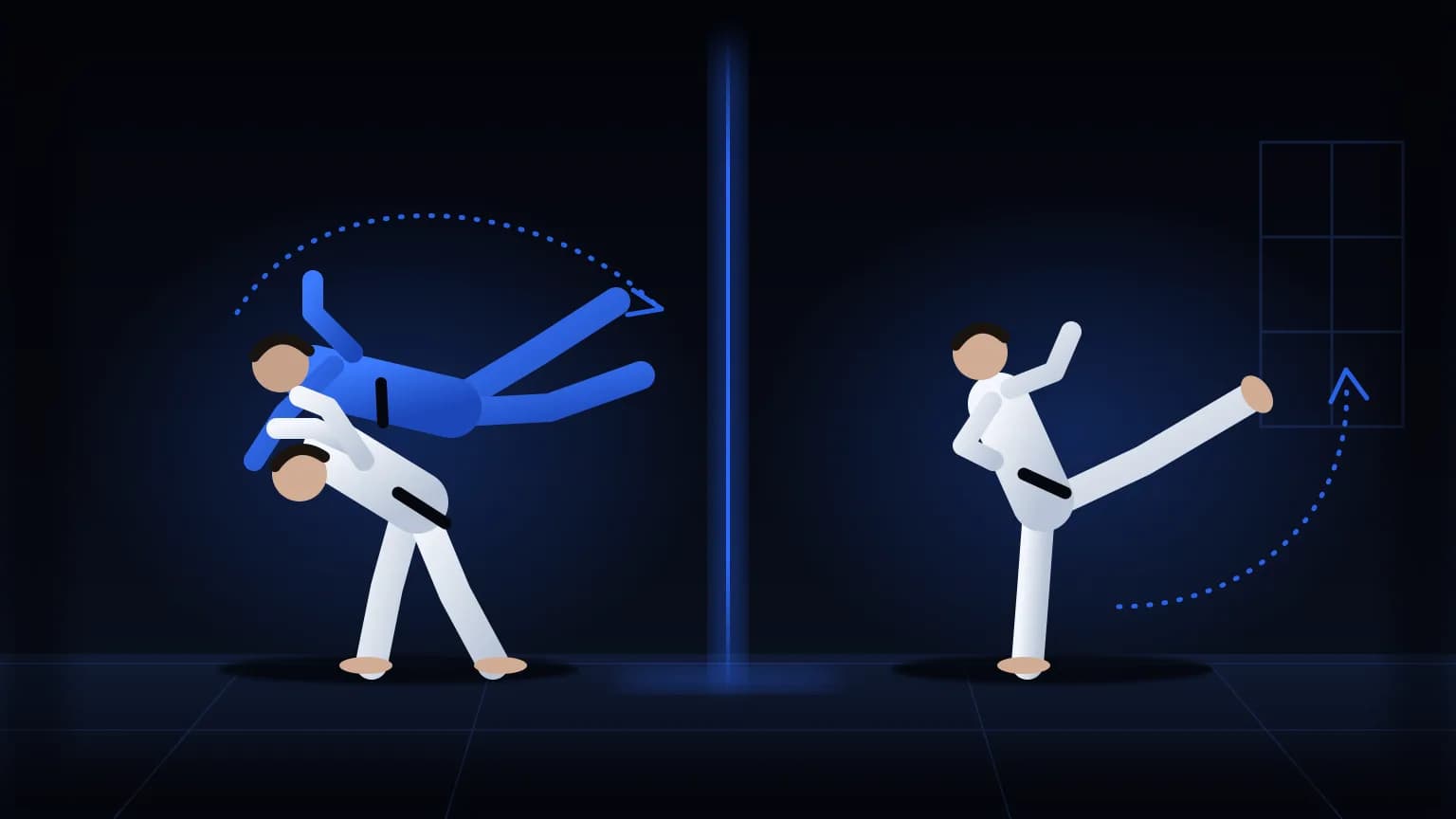
Pick judo if you want to grip, throw and hold a resisting partner at full speed from your first month. Pick karate if you want to learn striking at a distance, with kicks and punches scored under light-contact rules. Both are real combat sports with their own world federation, and the rulebooks show exactly where they split.
Below, you get a side-by-side table built from the 2026 rules of the International Judo Federation (IJF) and the World Karate Federation (WKF), the injury data researchers published, the age rules for kids, and a checklist for your trial class. You also get a plain answer on self-defense: what the research measured, and what it never tested.
See judo and karate side by side
| Judo | Karate (WKF sport kumite) | |
|---|---|---|
| What you train | Gripping, off-balancing, throws, pins, chokes and armlocks | Punches, strikes, kicks, blocks, distance and timing |
| Contact with your partner | Constant: you hold the jacket and move each other's weight | Light to controlled: you score from a distance and break apart |
| Senior contest length | 4 minutes of real time, then golden score with no time limit | 3 minutes of effective time |
| How you win | One clean throw on the back, a 20 second pin or a tap-out ends it | First to a lead of 8 points, or most points at time |
| Points | Waza-ari and ippon | Yuko 1, waza-ari 2, ippon 3 |
| Throws | Score the contest | Sweeps and hip-level throws allowed, over-the-shoulder and sacrifice throws forbidden |
| Ground fighting | Pins, chokes and armlocks | None as a skill: a legal technique on a fallen opponent scores 3 points |
| Olympic status | Olympic sport since Tokyo 1964 | Held once, at Tokyo 2020. Absent from Paris 2024 and Los Angeles 2028 |
| First IJF or WKF age category | Cadets from age 15 at IJF events | Under 14 category at ages 12 and 13 |
| Ranks | Kyu grades, then dan grades | Depends on your style and club |
Every row in the table comes from a rulebook or a study. You find the sources at the bottom, and each section below explains one row.
Watch how each contest scores
In judo, the throw is the point. IJF rules give you ippon when you throw your opponent on the back with four qualities: speed, force, landing on the back and skilful control until the landing ends. The IJF Sport and Organisation Rules also give you ippon when you hold a pin for 20 seconds, when your opponent taps twice or says "maitta", or when your opponent loses consciousness. A 10 to 19 second pin scores waza-ari. Read the judo rules guide for penalties and golden score.
In karate, the WKF Kumite Competition Rules 2026 pay you 1 point for a punch or strike to a scoring area, 2 points for a kick to the body and 3 points for a kick to the head. Three points also go to any legal technique against an opponent who is touching the mat with anything but their feet. Your bout ends when you lead by 8 points or hold the most points at time. If you tie, the first fighter to score wins.
Karate rules do let you throw, but only in a narrow way. Articles 10.4.7 to 10.4.8 allow sweeps such as de-ashi-barai and ko-uchi-gari and throws where your pivot stays at or below hip level. They forbid over-the-shoulder throws and sacrifice throws. A karate throw sets up your scoring strike. A judo throw is the score.
Compare range, contact and what you practise
Judo starts at grip range. You grab the sleeve and lapel, break your partner's balance and throw. Your class drills look like uchikomi, the repeated entry without the finish, and randori, free practice against a resisting partner. Karate starts at kicking range. You drill kihon, kata and kumite, and you learn to move in and out of striking distance.
That difference shapes your first month:
- Judo: you spend the first weeks on breakfalls, because you get thrown every class. Read the ukemi guide to see what that looks like.
- Karate: you spend the first weeks on stance, punch and kick form, and on moving without a partner holding you.
Judo gives you more physical contact per minute. Karate gives you more room to practise alone. If you want to learn at home between classes, karate transfers more easily, and the guide to training judo at home shows what you can still do alone for judo.
Read the injury data without ranking the sports
No study compares judo and karate injuries with the same method, so you cannot rank them. Each study counts differently, which means you read each number on its own.
For judo, Lystad and colleagues followed combat sports across three Olympic Games and measured 9.6 injuries per 1,000 minutes of competition in judo. That is one injury about every 104 minutes of exposure. In judo, 35.9% of injuries cost more than 7 days away from competition or training. Across all four combat sports the study measured, athletes who lost had 3.59 times the injury rate of the athletes who won.
Pocecco and colleagues reviewed the judo literature and reported an injury risk of 11 to 12% at the 2008 and 2012 Olympics. Sprains, strains and contusions of the knee, shoulder and fingers were the most common, and being thrown was the most common way you got hurt. Severe injuries were rare and usually hit the brain or spine. In young judoka, contusions, abrasions, fractures and sprains led the list.
For karate, a systematic review and meta-analysis of 28 studies pooled 88.3 injuries per 1,000 athlete-exposures and 39.2 per 1,000 minutes. That is one injury about every 25 minutes of competition, or every 11 bouts. The head and neck took the most hits (median 57.9% of injuries), contusions led the injury types (median 68.3%) and lacerations followed (median 18.6%). Most injuries were in the least severe category.
Use these numbers like this:
- Expect different injuries. Judo hurts your joints and your landing. Karate sport rules hurt your head and face more often, mostly with bruises and cuts.
- Compare your protection. WKF rules make mitts, a gum shield, a body protector, shin pads and foot protection compulsory, and add a helmet for athletes under 14. Ask your club what it requires.
- Treat the rates as competition rates. Your first year in class involves far fewer hard contests than an Olympic bout.
Test the self-defense claim before you trust it
Neither federation rulebook claims self-defense results, and no trial in the sources above compares judo with karate in a street fight. The research that does exist measures one thing you can verify: falling.
Groen and colleagues taught 25 older adults martial arts fall techniques in five sessions. Fall performance rose by a mean of 1.6 points on a ten-point scale, and better technique reduced the force on the hip in a sideways fall. A randomized trial of the Judo4Balance programme enrolled 200 community-dwelling adults with a mean age of 72. Those who learned falling techniques in 6 to 9 weeks kept their fall competence at the 20 month follow-up.
Both studies used judo-style falls in a gym, on adults who volunteered. They do not prove you win a fight. They do show that you can learn to land safely, which protects you on ice, on stairs and in a push. Karate trains you to work at striking distance. Judo trains you to work inside grip range, where you get grabbed and thrown. Decide which situation worries you more.
Pick by your goal
| Your goal | Start with | Why |
|---|---|---|
| Compete in an Olympic sport | Judo | Judo has Olympic status. Karate has no Olympic event after Tokyo 2020 |
| Learn to fall and stay on your feet | Judo | The two fall studies above trained judo-style falls |
| Learn striking and distance | Karate | Your scoring techniques are punches and kicks |
| Train with a partner every class | Judo | Your drills are contact drills from week one |
| Practise alone at home | Karate | Kihon and kata need no partner |
| Add takedowns to another art | Judo | Throws are the scoring unit. See judo vs BJJ for the ground game |
| Train for fitness with a clear grading path | Either | Compare each club's syllabus, as in the judo belt order guide |
If you are torn, choose the club, not the art. A coach you trust, a mat you feel safe on and a class time you keep will teach you more than the label on the door.
Choose for your kid with the age rules
Federations set minimum ages for competition, and you can use them as a guide for how seriously each art treats young bodies.
The IJF sets 15 as the lower age limit for IJF competitions, counted in calendar years. It recommends youth categories at 13 and 14 (3 minute contests) and at 11 and 12 (2 minute contests), and it lists no competition for ages 9 and 10. National federations write their own youth rules. Enter your child's birth year in the judo age categories calculator to see the IJF category for any season.
The WKF sets age categories for kumite: Under 14 for ages 12 and 13 (1.5 minute bouts), Cadet for 14 and 15, Junior for 16 and 17, and Under 21 for 18 to 20. Cadet and junior bouts last 2 minutes, and for Cadet and Under 14 competitions a head technique scores when you stop within 10 cm for kicks and 5 cm for hand techniques.
Use this to choose:
- Age 5 to 8: pick the club with the best children's class and a coach who teaches falling or basic stance first. Ask each club about its children's class, because neither federation rulebook sets competition rules this young.
- Age 9 to 12: pick judo if your child likes wrestling-style play and learns fast from rolling. Pick karate if your child likes form, kata and clear steps.
- Age 13 and up: pick based on competition goals. Judo has the Olympic path, and karate has WKF youth leagues.
Ask any club how it handles a child who does not want to be thrown or hit. A good coach lets your child stop.
Run a trial class checklist
Book one trial class at a judo club and one at a karate club, then score each club on the same checklist.
- Watch the warm-up. You want controlled movement and a coach who corrects it.
- Count the beginners. A class with new people shows you a real beginner path.
- Check the floor. Judo needs a padded mat you can land on. Ask any club what you land on and how it cleans it.
- Ask who teaches the beginners. You want an instructor with a recognised grade from the national federation.
- Ask what you wear and what it costs. Ask for the monthly fee, the uniform cost, the grading fee and the federation membership, because each club sets them differently.
- Ask how sparring works. In judo, ask when you start randori. In karate, ask whether the club follows WKF light-contact rules or a full-contact style.
- Ask who a beginner can train with. You want partners who control their strength.
- Check how you feel the next morning. Soreness is normal. Sharp joint pain is not.
Pick the club with the highest score, whatever the art. Try both for four weeks if your schedule allows it.
Avoid these mistakes
- You judge by film. Fight scenes show you the highlight, not a Tuesday class. Visit a real one.
- You pick by belt colour. Belt systems differ by federation and club. In judo, kyu grades come before dan grades. For karate, ask your club which style's grades it uses.
- You expect a throw to work on day one. Judo throws need grips and balance. Give yourself 8 to 12 weeks before you judge. The judo for beginners guide gives you a 12-week plan.
- You skip the breakfalls. Learn the falls first, then the throws. The judo throws list lists them by class.
- You mix both arts in week one. Learn one art for three months, then add the other.
- You ignore the words. Class runs faster when you know the terms. Drill them with the judo terms trainer.
Common questions
Is judo or karate better for beginners?
Neither wins on difficulty. Judo gives you partner contact and breakfalls from the first class. Karate gives you solo form work and distance. Your best pick is the club with the coach you trust and a class time you keep.
Is judo or karate better for self-defense?
The sources here do not answer that for a street fight, because no trial compares the two. They do show that you can learn judo-style falling skills quickly, and those skills protect you in any slip or shove.
Is judo or karate better for kids?
It depends on your child. Judo suits kids who enjoy rolling and wrestling-style play. Karate suits kids who like clear steps, form and kata. The IJF lists no competition for ages 9 and 10, and the WKF starts its Under 14 category at age 12.
Which one is an Olympic sport?
Judo has been Olympic since Tokyo 1964. Karate appeared at Tokyo 2020 and is not on the Paris 2024 or Los Angeles 2028 programmes, according to the WKF.
Which one gets you hurt more?
You cannot tell from the published data, because researchers count each sport differently. Judo injuries cluster in the knee, shoulder and fingers from being thrown. Karate sport injuries cluster in the head and neck, mostly as bruises and cuts.
Can you train judo and karate together?
Yes, after your first few months. Learn one art well enough to know its habits first. Judo trains you to close the distance and grip, and karate trains you to manage the distance, so each art asks your reflexes for something different.
Do you need a gi to start?
Most clubs lend you one for a trial class. Judo uses a heavy jacket because your partner grips it, and a judogi that fits matters more than in karate. Use the judogi size calculator before you buy.
Sources
- International Judo Federation. Sport and Organisation Rules, version 14 August 2026
- International Judo Federation. History of judo
- World Karate Federation. Kumite Competition Rules, valid from 1 January 2026
- World Karate Federation. Olympic Games Karate competition: what is kumite?
- World Karate Federation. Karate: Paris 2024 greatest absence
- Lystad RP et al. Injury incidence, severity and profile in Olympic combat sports. Br J Sports Med, 2021
- Lystad RP et al. Epidemiology of injuries in Olympic-style karate competitions. Br J Sports Med, 2020
- Pocecco E et al. Injuries in judo: a systematic literature review including suggestions for prevention. Br J Sports Med, 2013
- Groen BE et al. Martial arts fall training to prevent hip fractures in the elderly. Osteoporos Int, 2010
- Arkkukangas M et al. High challenge exercise and learning safe landing strategies among community-dwelling older adults: a randomized controlled trial. Int J Environ Res Public Health, 2022
- United States Judo Federation. Judo vocabulary