
Training guide
How Long Does It Take to Get a Black Belt in Judo?
Plan on 2 to 5 years. See the minimum time and age for 1st dan at the Kodokan, the IJF, British Judo, Judo Canada, the USJA and USA Judo, grade by grade.
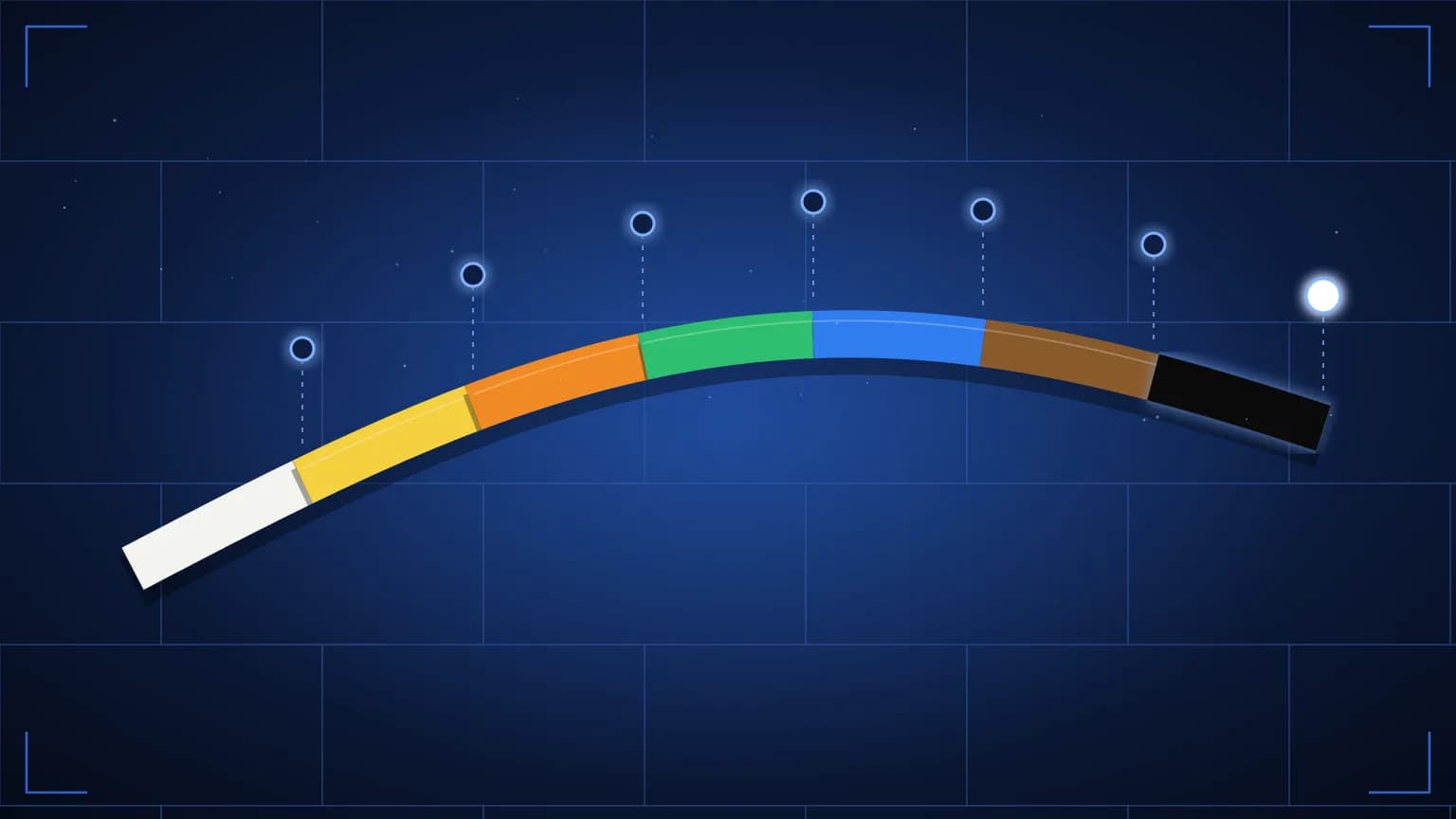
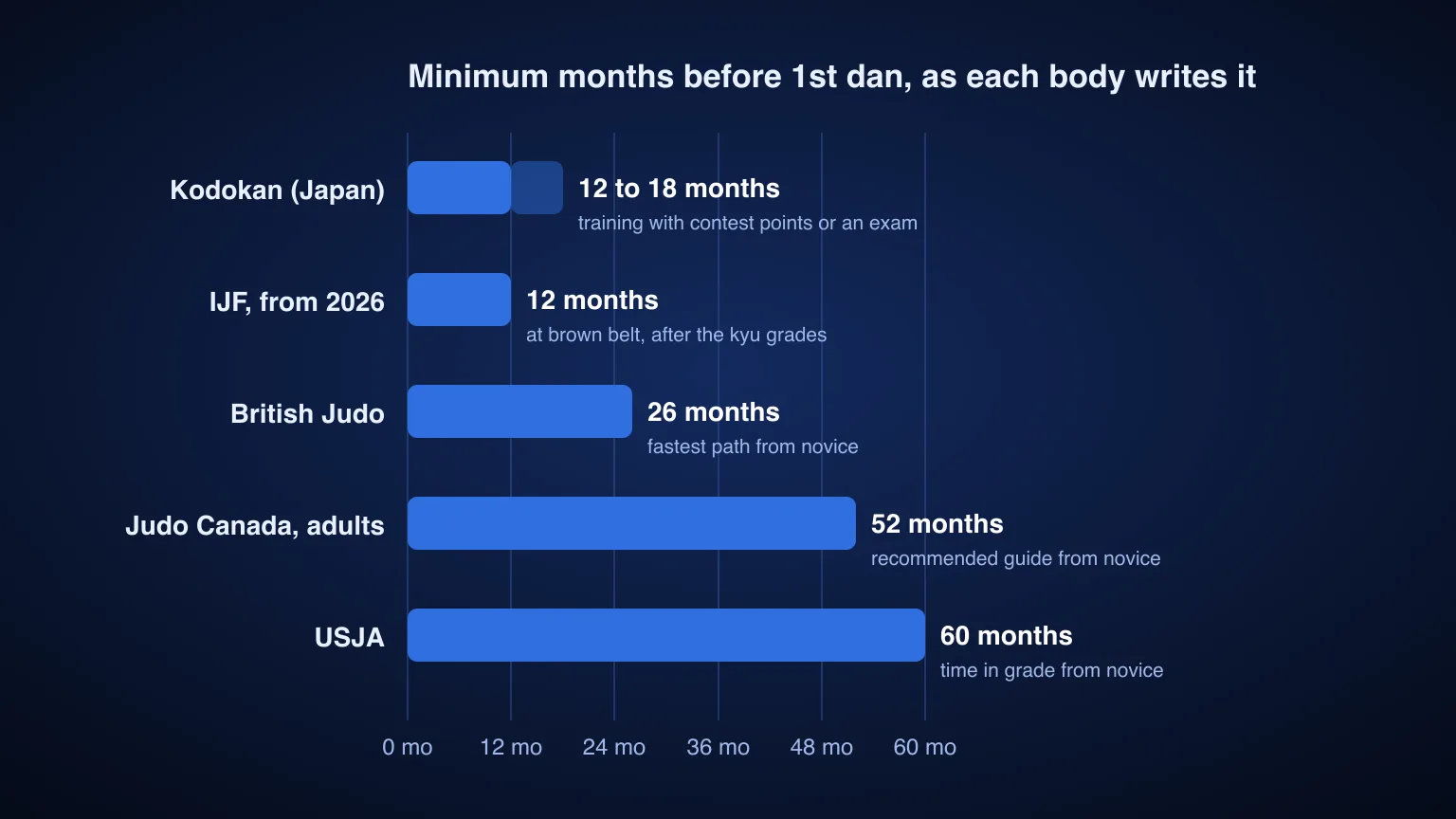
Plan on 2 to 5 years of steady training from your first class to 1st dan, the black belt judoka call shodan. Your federation sets the floor: the Kodokan in Japan asks for 1 to 1.5 years of training plus contest points or an exam, the IJF asks for a year at brown belt and an age of 15, British Judo's minimums add up to about 2 years and 2 months, and the USJA's time in grade adds up to exactly 5 years.
Nobody publishes one number for everyone, because every body counts its own way. This guide puts the rules side by side, adds them up grade by grade, and shows what slows most judoka down.
Compare the minimums for 1st dan
The table lists what each body publishes for the step to shodan. Time in grade means the months you must hold your current grade before you may test for the next one.
| Body | Minimum age for 1st dan | Minimum time before 1st dan | What else you need |
|---|---|---|---|
| Kodokan (Japan) | 14 | 1 year of training with 6 contest points, or 1.5 years with 3 points or a practical exam | The first three sets of nage-no-kata |
| IJF (from January 2026) | 15 | 1 year at brown belt | A talk on your judo background, a history test, the full nage-no-kata, and 5 throws and 5 groundwork techniques drawn at random |
| British Judo | 15 | 1 year as 1st kyu | 100 contest points, a skills exam and the Level 1 nage-no-kata certificate |
| Judo Canada | 15 | 6 months as 1st kyu (competitive) or 1 year (technical) | 100 points and a formal grading with the first 3 sets of nage-no-kata |
| USJA | 15 | 1 year as 1st kyu, with 96 classes | A knowledge test and a demonstration of throws, pins, chokes and armlocks |
| USA Judo | 15 | 3 years in grade without competition points, down to 6 months with 20 points | The first 9 throws of nage-no-kata, randori and your contest record |
| Judo Australia | 18 (17 in exceptional cases) | Set by pathway | Contest, service or knowledge pathways |
Two rules sit behind every row. Promotion is never automatic: USA Judo writes that its time in grade is a minimum benchmark and that promotion is not automatic even with time in grade. And your membership counts: British Judo evidences time in grade through full membership, and Judo Australia counts only years of continuous financial membership, so a lapsed card can cost you months.
Add up the grades before the black belt
The step to shodan is only the last wait. Before it, you climb the coloured kyu grades, and each body sets its own spacing.
British Judo: about 2 years at the fastest
British Judo uses six senior kyu grades: red, yellow, orange, green, blue and brown. You may go up one grade per calendar month until 5th kyu, then one grade every three calendar months from 4th kyu. At the fastest, you reach 1st kyu, the brown belt, after 14 months, and 1st dan after 26 months once you add the year as 1st kyu. The British Judo kyu syllabus itself expects 1st kyu in approximately three years, or two for a keen judoka, which puts most adults at 3 to 4 years for the black belt.
USJA: exactly 5 years of time in grade
The USJA lists a time in grade and a class count for every rank. From novice you need 3 months to 6th kyu, then 5, 7, 10, 11 and 12 months for each step to 1st kyu, and 1 year more as 1st kyu before shodan. That adds up to 60 months and at least 96 classes in each of the last two grades.
Judo Canada: about 4 years and 4 months for adults
Judo Canada recommends 8 months at each coloured belt for judoka aged 16 and over, and a year from brown to black. Five steps of 8 months plus that year come to 52 months. Its national syllabus allows a faster competitive stream, with 6 months as 1st kyu and 100 points.
The Kodokan: the shortest written minimum
The Kodokan asks for 1 year of training with at least 6 contest points, or 1.5 years with 3 points, before shodan, and it lets a candidate with the 1.5 years take a practical exam instead of collecting points. Japanese judoka often start as children, so many reach the age of 14 with years of practice behind them.
Count your own date with one example
Say you are 30, start judo in Britain in January, grade every time the rules allow and pass first time.
- 6th kyu (red): one month after you start, in February.
- 5th kyu (yellow): March.
- 4th kyu (orange): three months later, in June.
- 3rd kyu (green): September.
- 2nd kyu (blue): December.
- 1st kyu (brown): March of your second year, month 14.
- 1st dan: March of your third year, month 26, if you also hold 100 contest points and pass the skills exam and the nage-no-kata certificate.
Now add real life. Clubs do not grade every month, injuries happen, and 100 points take competition you might not want. With a club that grades every three months and two years at brown belt while you collect points, the same judoka tests at month 42, three and a half years in. That is why most people need 3 to 5 years, and why the fastest legal path rarely happens.
Know what the shodan exam asks of you
Every exam mixes three things: your throws and groundwork, a kata, and proof of activity.
- Kata. Nage-no-kata, the forms of throwing, appears everywhere. The Kodokan tests its first three sets (hand, hip and foot throws), Judo Canada and the USJA ask for sets you perform as tori, USA Judo asks for its first 9 throws, and the IJF's new rules ask for the complete kata. Learn the sets in our nage-no-kata guide.
- Techniques on demand. The IJF draws 5 throws and 5 groundwork techniques at random from the Kodokan Gokyo and its programme. Judo Canada asks for 8 throws, 3 pins, 3 chokes and 3 armlocks. Revise them with the judo throws list.
- Contest points or service. British Judo and Judo Canada count 100 points, the Kodokan counts 3 to 6, and USA Judo shortens its time in grade from 3 years to 6 months as your points grow from 0 to 20. A win against an opponent of your own grade earns 1.0 point under both USA Judo and the Kodokan.
Plan for a child's black belt
Every body here sets a minimum age of 14 or 15 for shodan, and Judo Australia sets 18. A child who starts at 6 therefore spends years in the junior grades.
- Britain: juniors climb 18 mon grades from age 8, and the 18th mon converts to 1st kyu at 14. A 1st kyu under 15 may collect dan points but registers the black belt only at 15.
- Canada: Judo Canada recommends 2 years per early belt for children under 10 and warns that a judoka who reaches a belt young will wait a long time for the next one.
- USA Judo: its junior rank program expects a brown belt at around 14 to 15.
Read the judo belt order guide to see the colours your child will wear, and check which competitions open at each age with the judo age categories tool.
Avoid the mistakes that cost you months
- Letting your membership lapse. British Judo and Judo Australia count your time in grade through your membership. Renew before it runs out, and register each new grade the week you pass.
- Training without a calendar. Ask your coach for the next two years of grading dates on day one and plan backwards.
- Collecting points too late. If your route needs contest points, enter your first shiai as soon as you reach brown belt, so the points build during your year at 1st kyu. Practice keeping score of a club contest with the judo scoreboard so the rules feel normal before your first event.
- Learning the kata in the last month. Nage-no-kata takes a partner and dozens of sessions. Start it at 2nd kyu.
- Ignoring the age rule. A 13-year-old brown belt waits for the 15th birthday whatever their skill. Use the time for kata and contest experience.
Reach shodan sooner without cutting corners
You cannot skip the minimums, but you can stop losing months around them. Train at least three times a week, so each grading finds you ready. Compete once a quarter from brown belt if your route counts points. Film your tokui-waza, your favourite throw, every few weeks so you see whether your kuzushi and entry improve between gradings. And learn the rules of contest judo in our judo rules guide before your first shiai.
Get quick answers
How many years does it take to get a black belt in judo?
Two to five years for most adults. The written minimums range from 1 year of training at the Kodokan to 5 years of time in grade under the USJA, and most people need longer than the minimum because clubs do not grade every month.
Can you get a black belt in judo in one year?
Only in Japan, and only with contest results: the Kodokan's minimum is 1 year of training with 6 contest points. Outside Japan, the grades before 1st kyu and the year as 1st kyu make one year impossible under the rules in this guide.
Do you have to compete to get a judo black belt?
No. British Judo's technical scheme examines your technical knowledge instead of your contest skill, with its own age and time-in-grade rules, and the Kodokan lets a candidate with 1.5 years of training take a practical exam instead of collecting points. The USJA counts time in grade and classes. Competing still gets you there sooner: USA Judo cuts its 3 years at brown belt to 6 months as your points grow.
What is the minimum age for a judo black belt?
Fifteen under the IJF, British Judo, Judo Canada, the USJA and USA Judo. The Kodokan allows 14, and Judo Australia sets 18, or 17 in exceptional cases.
How long do you stay a brown belt in judo?
At least 1 year as 1st kyu under the IJF, British Judo and the USJA, 6 months on Judo Canada's competitive stream, and 3 years under USA Judo without contest points, which points cut to 6 months.
How long from 1st dan to 2nd dan?
One year under the IJF and Judo Canada's competitive stream, 2 years under British Judo, and 4 years under USA Judo without points, shortened by contest points.
Is a judo black belt harder to get than a karate black belt?
The time is similar, but judo adds contest points or a kata exam at nearly every step. Compare the two arts in our judo vs karate guide.
Check the sources
- USA Judo, Promotion Recommendation Procedures, 30 July 2025
- USA Judo, General Guidelines for the Junior Rank Program
- USJA, Promotion System
- British Judo, Dan Grade Promotion Syllabus, July 2025
- British Judo, Kyu Grade Promotion Syllabus, January 2025
- British Judo, Mon Grade Promotion Syllabus, December 2024
- British Judo, grading FAQs, November 2025
- Judo Canada, National Grading Syllabus, 2025
- Judo Canada, National Kyu Grading Syllabus, June 2021
- Judo Australia, National Grading Policy, March 2023
- Kodokan, dan promotion requirements (Japanese)
- IJF, Rules for the awarding of IJF official judo dan grades, January 2026
- IJF, Grades and Dan Regulations, January 2026
- Judo AI: Dojo Partner on the App Store